Gas prices crossed $4.02 per gallon nationally in April 2026 — the highest average since 2022. If you’re filling up a 15-gallon tank, that’s over $60 every single time. Over the course of a year, the average American driver spends well over $2,000 on fuel alone. Learning how to find cheap gas near you isn’t just a nice-to-have skill — it’s a genuine money-saver that can put hundreds of dollars back in your wallet annually.
The good news? Finding cheap gas has never been easier. Between dedicated apps, warehouse club memberships, credit card rewards, and grocery store programs, there are more ways than ever to slash your fuel costs. In this guide, we’ll walk you through every strategy — ranked from easiest to most impactful — so you can start saving on your very next fill-up.
Table of Contents
- Best Apps to Find Cheap Gas Near You
- Use Google Maps or Waze to Compare Prices
- Join a Warehouse Club (Costco, Sam’s Club, BJ’s)
- Use a Gas Rewards Credit Card
- Earn Gas Discounts Through Grocery Stores
- Sign Up for Gas Station Loyalty Programs
- Pay Cash When It Makes Sense
- Buy Gas at the Right Time
- Choose the Right Location to Fill Up
- Don’t Pay for Premium If You Don’t Need It
- Improve Your Driving Habits to Use Less Gas
- Stack Multiple Strategies for Maximum Savings
- Frequently Asked Questions
1. Best Apps to Find Cheap Gas Near You
The fastest and most reliable way to find cheap gas is by using a dedicated gas price app. These apps crowdsource real-time fuel prices from drivers and station owners, so you can see exactly which station near you has the lowest price before you ever leave home.
GasBuddy
GasBuddy is the most popular gas price app in North America, with over 100 million downloads. The app lets you search for the cheapest gas near you by ZIP code, city, or current location. You can filter by fuel type (regular, mid-grade, premium, or diesel) and sort by price or distance.
Beyond just showing prices, GasBuddy also offers a free GasBuddy card that you can link to your bank account. When you pay using the GasBuddy card at the pump, you can save up to 33 cents per gallon on top of the already-discounted price. Over the course of a year, that adds up fast.
GasBuddy is free to download on both iOS and Android. Price reports are updated by other users, so the more you use it — and contribute your own price reports — the more accurate it gets.
Upside
Upside is one of the best GasBuddy alternatives and works on a straightforward cash-back model. You browse participating gas stations near you, claim an offer (usually 10–25 cents back per gallon), fill up, and upload your receipt. Your cash back is deposited to your Upside account with no expiration date.
You can cash out via PayPal, bank transfer, or gift cards to popular retailers. The selection of partner stations varies by location, but Upside has grown significantly and is now available at thousands of stations across the US.
Checkout 51
Checkout 51 is a rebate app that works similarly to Upside. Browse gas offers near you, fill up, snap a photo of your receipt, and earn cash back. Offers typically go up to 25 cents per gallon and rotate weekly. Once your balance hits $20, you can cash out by check.
AAA Mobile
If you’re already an AAA member, the AAA Mobile app includes a gas price finder as part of your membership. It shows current prices at nearby stations, lets you filter by fuel type, and includes AAA-exclusive discounts at partner stations. Even if you’re not a member, AAA’s web-based Gas Price Finder at their website is free to use.
GasPrices.com / GasGuru
GasGuru is a simple, clean app that pulls data from the Oil Price Information Service (OPIS), which provides real-time data used by many industry professionals. It’s fast, accurate, and shows a map view of prices near you. It’s a great backup app to cross-reference with GasBuddy.
2. Use Google Maps or Waze to Compare Prices
You don’t even need a dedicated gas app if you already use Google Maps or Waze — both show gas prices directly.
In Google Maps, simply tap the search bar and type “gas stations near me.” The results list will show each station along with its current per-gallon price for regular gasoline. You can tap on any station to see more fuel types and read reviews. This is especially handy while you’re already driving.
In Waze, tap the magnifying glass, select the gas pump icon, and Waze will display nearby stations sorted by a combination of price and distance. Waze also integrates with your route, so it can suggest a cheap gas station along your current path — no detour needed.
Both apps update prices regularly through user contributions, and Google Maps prices are often especially accurate because they pull data from partner networks. This method requires zero extra apps and zero setup — just open the map you already use.
3. Join a Warehouse Club (Costco, Sam’s Club, BJ’s)
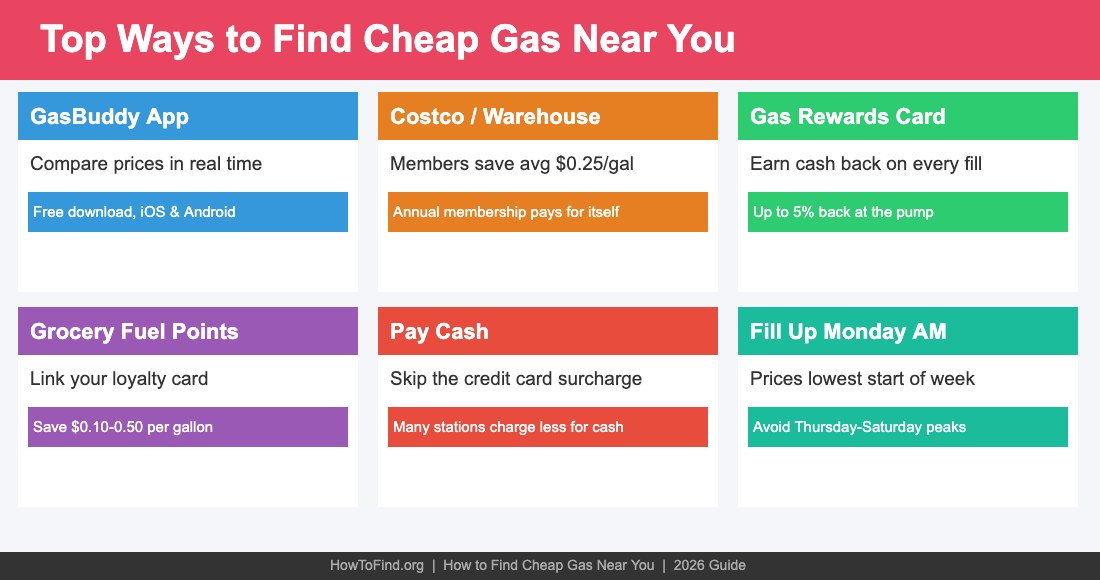
If you drive more than 10,000 miles a year, a warehouse club membership often pays for itself in gas savings alone. Costco, Sam’s Club, and BJ’s Wholesale Club all operate member-only gas stations that consistently price fuel 15–25 cents below the regional average.
A U.S. News analysis found that in 2026, Costco gas was routinely 20–30 cents cheaper per gallon than comparable stations in the same zip code. On a 15-gallon fill-up, that’s $3–$4.50 saved every single time.
Here’s a quick breakdown:
- Costco: Annual membership costs $65 (Gold Star) or $130 (Executive). Gas is available at most Costco locations during store hours. The Executive membership ($130/year) includes 2% cash back on most purchases, which can further offset the cost. Paying with the Costco Anywhere Visa® Card by Citi earns an additional 4% back on gas.
- Sam’s Club: Membership starts at $50/year. Sam’s Club gas stations are available to members and often rank among the cheapest in their region. The Sam’s Club Plus membership ($110/year) includes Instant Savings benefits and free shipping on orders.
- BJ’s Wholesale Club: Based primarily in the Eastern US, BJ’s membership costs $55/year and its co-branded credit card offers 10 cents off per gallon at BJ’s stations — on top of the already-low member price.
The catch? Costco and Sam’s Club gas stations often have long lines, especially on weekends. Plan your fill-ups on weekday mornings for the shortest wait. Also check that there’s a location near your regular commute route before joining.
4. Use a Gas Rewards Credit Card
One of the most underrated ways to save on gas is to pay with the right credit card. Gas rewards cards can effectively knock 3–5% off every gallon — indefinitely, without any apps or line-waits.
Here are some of the top options:
- Costco Anywhere Visa® by Citi: 4% back on gas at any station (up to $7,000/year), 4% on EV charging, and additional rewards on restaurants and travel. Requires a Costco membership.
- Blue Cash Preferred® Card from American Express: 3% cash back at US gas stations with no annual fee on the base card. If you also shop at US supermarkets, the Blue Cash Preferred gives 6% back there too.
- Sam’s Club Mastercard: 5% back on gas anywhere (up to $6,000/year), then 1% after. No annual fee beyond Sam’s Club membership.
- PenFed Platinum Rewards Visa Signature® Card: 5X points on gas purchases, with points redeemable for statement credits or travel. Requires PenFed Credit Union membership (free to join).
- Citi Custom Cash® Card: Automatically earns 5% back in your top eligible spend category each billing cycle — if gas is where you spend the most, you earn 5% back, up to $500/month.
The key to making gas credit cards work: always pay the balance in full each month. Interest charges will quickly wipe out any rewards you earn. If you carry a balance, focus on the other strategies in this guide instead.
5. Earn Gas Discounts Through Grocery Stores
Dozens of major grocery chains offer fuel rewards programs that let you earn cents-off-per-gallon discounts simply by shopping for food you’d buy anyway. This is one of the most passive ways to save on gas.
Here’s how the most popular programs work:
- Kroger Fuel Points: Earn 1 fuel point for every $1 spent at Kroger stores (and affiliated brands like Fry’s, King Soopers, Fred Meyer). Every 100 points = 10 cents off per gallon at Kroger or Shell partner stations, up to 35 gallons. Special promotions can boost your points multiplier to 4x on certain purchases.
- Safeway / Albertsons: Similar fuel rewards program. Every $100 spent earns around 10 cents off per gallon at participating stations.
- Giant / Stop & Shop: Gas rewards earned on grocery purchases, redeemable at Giant Gas stations or Shell. Buying gift cards at the grocery store often earns extra fuel points — a useful trick for stacking savings.
- Hy-Vee Fuel Saver + Perks: Popular in the Midwest, this program lets you earn and redeem fuel discounts at Hy-Vee and Casey’s General Stores.
- Tops Markets: Tops Gas Advantage program gives you fuel discounts tied to your weekly grocery spend.
Pro tip: Many grocery stores offer bonus fuel points when you purchase select gift cards. If you plan to buy a gift card for a store you already use (Amazon, Target, restaurants), buy it through the grocery store first to earn fuel points on that amount.
6. Sign Up for Gas Station Loyalty Programs
Most major gas station chains now have their own loyalty apps that offer discounts just for being a member. These programs are free to join and can save you 3–10 cents per gallon immediately.
- Shell Fuel Rewards: The Shell app gives you instant discounts on Shell gas. New members often get a first-fill bonus of 25 cents off per gallon. Ongoing savings include Gold Status discounts of 5 cents off per gallon, earned by fueling up regularly.
- ExxonMobil Rewards+: Earn points on fuel and convenience store purchases. Points can be redeemed for cents off per gallon. Also integrates with Alexa for hands-free payment at some stations.
- Circle K Inner Circle: Free membership program that offers surprise deals, fuel discounts, and bonuses tied to beverage purchases.
- BP Driver Rewards: Earn points on fuel and in-store purchases, redeemable for cents off per gallon. Integrates with BPme, their mobile app, for pay-at-pump convenience.
- Speedway Rewards / Speedy Rewards: Now under the 7-Eleven umbrella, Speedy Rewards lets you earn points on fuel and in-store items, redeemable for free products and fuel discounts.
If you have a preferred station you visit regularly, always download their loyalty app. The sign-up discount alone often saves you money on your first fill-up.
7. Pay Cash When It Makes Sense
Many gas stations charge a higher price per gallon for credit card transactions — often 5–10 cents more — to offset the processing fees they pay. When there’s no credit card surcharge, paying cash doesn’t help. But at stations that display two different prices (cash vs. credit), paying cash can be a real savings.
Before assuming the cash price is better, do the math. If your gas rewards credit card earns 4% back and the cash discount is only 5 cents per gallon (roughly 1.2% at $4 gas), you’re still better off using the credit card. The cash discount only beats credit card rewards when the differential is large — think 10–15 cents per gallon or more.
Also note that some stations offer cash discounts only if you go inside to pre-pay, which isn’t always practical. Check the price difference before committing.
8. Buy Gas at the Right Time
Gas prices fluctuate throughout the week, and several studies have confirmed consistent patterns you can use to your advantage:
- Monday and Tuesday tend to have the lowest gas prices of the week across most of the US.
- Thursday through Saturday prices typically rise as stations prepare for the weekend travel surge.
- Early morning is a good time to fill up because fuel density is slightly higher in cooler temperatures, meaning you get marginally more energy per gallon. This effect is small but real.
- Avoid filling up right before a holiday weekend. Prices spike predictably before Memorial Day, Fourth of July, and Labor Day as demand rises. Fill up 3–5 days early.
- Gas prices tend to drop in September and October as summer driving season ends and refineries switch to cheaper winter-blend fuel formulas. If you have a large tank, this is a good time to stock up.
You can also use GasBuddy’s “GasBuddy Trends” feature to see historical price charts for your area and predict when prices are likely to fall. This is especially useful before long road trips.
9. Choose the Right Location to Fill Up
Where you fill up can matter just as much as when. Here are location-based tips to remember:
- Avoid highway gas stations. Stations directly off highway exits consistently charge more — sometimes 30–50 cents per gallon more — because they have a captive audience. If you have time, drive two or three exits off the highway to find a cheaper local station.
- Avoid tourist areas and airports. Gas near airports, theme parks, or tourist zones is almost always overpriced. Fill up before you arrive.
- Look for competition clusters. When several gas stations are on the same block competing for the same customers, prices tend to be lower than in areas where one station has a local monopoly.
- Smaller independent stations often beat name-brand chains on price because they have lower overhead and brand licensing costs. If an unfamiliar station has 4+ stars on Google, it’s worth checking out.
- Costco, Walmart, and Murphy USA (often located near Walmart stores) consistently rank among the cheapest gas options in their respective areas. Murphy USA doesn’t require a club membership.
10. Don’t Pay for Premium If You Don’t Need It
Premium gas currently averages about 60–80 cents more per gallon than regular unleaded. If your car doesn’t require it, you’re literally burning money.
Check your car’s owner manual or the label inside the fuel door. If it says “premium recommended” — not “premium required” — your engine will run fine on regular gas. Modern engines with knock sensors automatically adjust timing to handle lower-octane fuel.
Only cars that require premium (usually high-performance engines and some luxury vehicles) actually need it. Using regular in a “recommended premium” car may result in a small reduction in performance and fuel economy, but often the price difference per gallon outweighs any efficiency gain from premium.
If your car truly requires premium, a higher-octane mid-grade fuel from a warehouse club station is often cheaper than regular from a highway gas station — worth keeping in mind.
11. Improve Your Driving Habits to Use Less Gas
Finding cheap gas is only half the battle. Using less of it is the other. A few simple changes to how you drive can improve your fuel economy by 10–30%:
- Slow down on the highway. Fuel economy drops sharply above 55 mph. Driving 70 mph instead of 60 mph can reduce your fuel economy by 15–20%.
- Accelerate and brake smoothly. Hard acceleration and sudden braking are the biggest gas-wasters in city driving. Anticipate traffic flow and coast to stops when possible.
- Keep your tires properly inflated. Under-inflated tires increase rolling resistance and can reduce fuel economy by 0.2–0.5% for every 1 PSI drop below the recommended pressure. Check monthly.
- Remove unnecessary weight. An extra 100 lbs in your car reduces fuel economy by about 1%. Clean out your trunk and cargo area.
- Use cruise control on the highway. Maintaining a steady speed is more efficient than the constant micro-adjustments of manual driving.
- Park in the shade. Hot fuel tanks can release vapors (wasted energy). Parking in shade also reduces the need to blast AC when you get in.
- Combine errands. Multiple short cold-start trips use far more fuel per mile than one continuous trip. Plan your routes to combine stops.
12. Stack Multiple Strategies for Maximum Savings
The real power comes from combining multiple strategies at once. Here’s what a high-savings stack looks like:
- Use GasBuddy to find the cheapest Costco gas station near you.
- Fill up on a Monday or Tuesday morning to get the weekly low price.
- Pay with the Costco Anywhere Visa card to earn 4% cash back on top of the already-low Costco price.
- Check the Upside app to see if there’s an additional cash-back offer at that station.
If the Costco station is 20 cents cheaper per gallon, the credit card gives you another 16 cents per gallon back (at $4/gallon), and Upside gives you 10 cents back — you’re effectively paying about $3.54 per gallon instead of $4.02. Over a year of weekly fill-ups, that’s well over $300 in savings.
You don’t need to stack every strategy every time. Even picking two or three consistently can save a typical driver $150–$300 annually without much effort.
How Much Can You Save?
Here’s a rough estimate of annual savings for a driver filling up 15 gallons per week (780 gallons/year) at current prices:
- GasBuddy app alone: ~$78–$156/year (finding stations 10–20 cents cheaper)
- Costco membership: ~$117–$195/year (15–25 cents cheaper per gallon), offsetting the $65 membership fee entirely
- Gas rewards credit card (4%): ~$125/year
- Grocery gas rewards: ~$60–$120/year depending on how much you spend at partner stores
- Combined stack: Potentially $300–$500/year or more
The numbers add up faster than most people expect. Small per-gallon savings multiply quickly across hundreds of fill-ups per year.
Frequently Asked Questions
What is the best free app to find cheap gas?
GasBuddy is the most widely used free app for finding cheap gas, with the largest network of user-reported prices. Google Maps and Waze are excellent alternatives if you prefer not to download an extra app. For cash back on top of low prices, Upside is highly rated.
Does Costco always have the cheapest gas?
Costco gas is consistently among the cheapest available in most markets — typically 15–30 cents below the regional average. However, you need a Costco membership, and their stations can have long lines. For non-members, Murphy USA (near Walmart locations) is another consistently low-priced option that requires no membership.
What day of the week is gas cheapest?
Monday and Tuesday are statistically the cheapest days of the week in most US markets, based on analysis of gas price data. Thursday and Friday tend to be the most expensive, as stations raise prices ahead of weekend travel demand.
Is premium gas worth it?
Only if your car’s manufacturer explicitly requires it. Check your owner’s manual or the sticker inside your fuel door. If it says “premium recommended” rather than “premium required,” you can safely use regular fuel without harming your engine. The price difference (60–80 cents per gallon on average) is rarely worth the minimal performance benefit for most drivers.
How does GasBuddy’s gas card work?
The GasBuddy card links directly to your checking account (like a debit card) and gives you instant savings of up to 33 cents per gallon at participating stations. Unlike a credit card, it doesn’t build credit or earn rewards points, but the per-gallon discount is hard to beat. There’s no annual fee, though some stations may charge a small transaction fee.
How can I find the cheapest gas on a road trip?
Use GasBuddy’s trip planner feature, which maps out the cheapest stations along your route. Alternatively, plan to fill up before reaching highway exits (where prices are higher) and use Google Maps to compare stations at each stop. Also check if there’s a Costco, Sam’s Club, or BJ’s near any of your overnight stops.
Do gas prices vary by neighborhood?
Yes, significantly. Studies have shown that gas prices can vary by 30–50 cents per gallon within the same city, often correlating with average income levels in an area — higher-income neighborhoods tend to have higher gas prices. Driving just a few minutes to a different neighborhood can sometimes yield meaningful savings.
What’s the best credit card for gas savings?
For pure gas savings, the Costco Anywhere Visa (4% back), Sam’s Club Mastercard (5% back), and PenFed Platinum Rewards Visa (5X points) are among the top performers. For a no-membership-required option, the Blue Cash Everyday® Card from American Express earns 3% at US gas stations with no annual fee.
Conclusion
With gas prices sitting above $4 per gallon in 2026, knowing how to find cheap gas near you is one of the easiest financial wins available. The strategies in this guide — from downloading GasBuddy to joining Costco, earning grocery fuel points, and using a gas rewards card — don’t require you to change your lifestyle. They just require a bit of setup upfront.
Start with what’s easiest: download GasBuddy and check it before your next fill-up. If you shop at a major grocery chain, sign up for their fuel rewards program this week. And if you drive frequently, run the numbers on a warehouse club membership — there’s a good chance it pays for itself in a month or two.
Every penny per gallon matters when you’re filling up week after week. Small changes compound into real savings. The tools are free, the savings are real, and your wallet will thank you.
Looking for more money-saving guides? Check out our articles on how to find cheap flights, how to find unclaimed money, and how to find your credit score.