
Knowing how to find cheap hotels can be the difference between a memorable trip and a budget disaster. Hotel costs are often the biggest single expense in any travel budget — sometimes even more than flights. Yet most travelers leave hundreds of dollars on the table simply because they don’t know where to look or when to book.
Whether you’re planning a weekend getaway, a family vacation, or a last-minute business trip, this guide will show you exactly how to find cheap hotels in 2026. We’ll cover the best booking websites, the ideal times to search, insider tricks the hotel industry doesn’t advertise, and how to use loyalty programs to get more for less.
By the end of this guide, finding affordable hotel rates will feel second nature — and you might even score a few upgrades along the way.
Table of Contents
- Why Hotel Prices Vary So Much
- The Best Websites and Apps to Find Cheap Hotels
- When to Book for the Best Hotel Prices
- Use Loyalty Programs and Credit Card Rewards
- Smart Search Strategies That Actually Work
- Alternative Accommodation Options
- How to Get Free Upgrades and Perks
- Red Flags to Watch Out For
- Tips for Different Types of Travelers
- Conclusion
- Frequently Asked Questions
Why Hotel Prices Vary So Much (And How to Use This to Your Advantage)
Before diving into strategies, it helps to understand why the same hotel room can cost $80 one night and $250 the next. Hotels use a pricing model called dynamic pricing (also called revenue management), which means rates change constantly based on supply and demand.
Key factors that drive hotel prices up include local events and conferences, holidays and school vacation periods, weekend vs. weekday demand (in city hotels, weekends are often pricier; in resort towns, weekdays are), and how many rooms are left unsold.
This is actually good news for savvy travelers. Because prices are driven by algorithms and occupancy predictions, there are reliable patterns you can exploit. A hotel that’s 80% booked three months out will charge peak prices. That same hotel with 30% occupancy two weeks before your arrival date is desperate to fill rooms — and that’s where the deals are.
Understanding this dynamic is the foundation of every money-saving strategy in this guide.
The Best Websites and Apps to Find Cheap Hotels
The single biggest mistake most travelers make is searching only one or two booking sites. In 2026, there are dozens of platforms competing for your booking, and prices can vary dramatically between them — sometimes by 20-40% for the identical room on the same night.
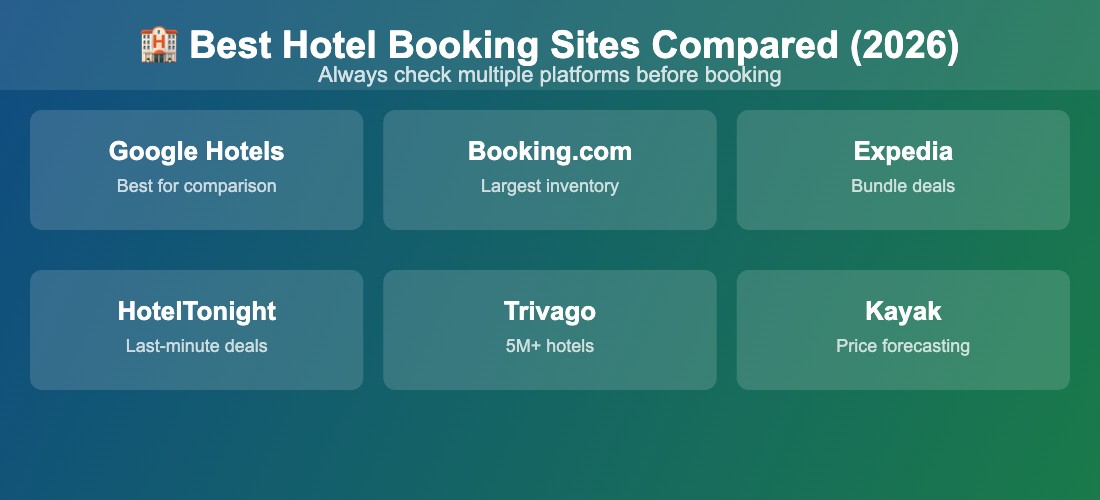
Best Hotel Comparison Sites
Comparison sites aggregate prices from multiple booking platforms, letting you see everything in one search. These are the best ones to use:
Google Hotels is now one of the most powerful free tools available. Search any hotel on Google and you’ll see a price comparison panel pulling data from Booking.com, Expedia, Hotels.com, and the hotel’s own website. It’s fast, visual, and now includes flexible date searching. Always start here.
Trivago compares prices from over 5 million hotels across hundreds of booking sites. It’s particularly good for finding deals on independent hotels that don’t show up prominently on major OTAs (Online Travel Agencies).
Kayak not only compares current prices but also has a “Price Forecast” tool that tells you whether rates for your dates are likely to go up or down. This is incredibly useful for deciding whether to book now or wait.
HotelsCombined (now part of Kayak) is another strong comparison engine worth checking for smaller, independent properties.
Best Direct Booking Options
Here’s something the booking apps don’t want you to know: hotels often offer their best rates directly on their own websites, especially if you sign up for their email list or loyalty program.
Major chains like Marriott, Hilton, Hyatt, and IHG all guarantee their lowest rates for direct bookings. Beyond the price, booking direct gives you better cancellation policies, easier modifications, and a direct relationship with the property if anything goes wrong.
When you find a good rate on a comparison site, always check the hotel’s own website before booking. If the direct rate is the same, book direct — you’ll often get perks like free breakfast or Wi-Fi thrown in.
Best Last-Minute Booking Apps
HotelTonight is designed specifically for last-minute bookings (within a few days of arrival). Hotels upload unsold rooms at steep discounts, often 30-50% off regular rates. It’s ideal if you’re flexible and not afraid to book 24-48 hours in advance.
Hotwire and Priceline’s “Express Deals” use a “blind booking” model — you get a deeply discounted rate but don’t see the exact hotel until after you book. You’re shown the star rating, general area, and amenities, which is usually enough to make a confident choice. These can yield some of the best deals available.
Booking.com’s “Genius” program and Expedia’s loyalty discounts give repeat users access to member-only prices that can be 10-15% cheaper than standard rates. Sign up for both — they’re free.
When to Book for the Best Hotel Prices
Timing your search and booking can save you as much as choosing the right platform. Here’s what the data actually shows about the best times to book cheap hotels.
Best Day of the Week to Book
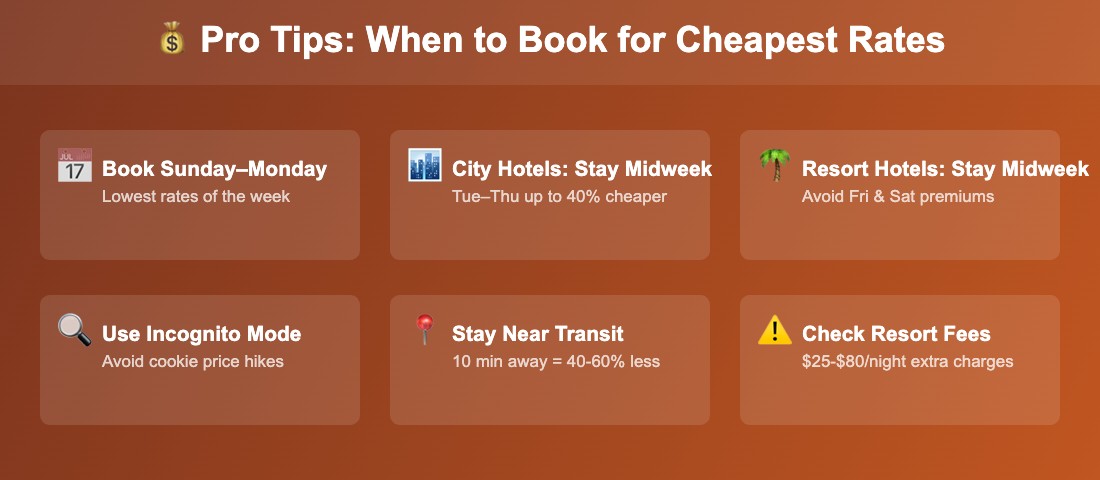
For city hotels (business-focused properties), weekday stays — Sunday through Thursday — are almost always cheaper than Friday and Saturday nights. The same hotel that charges $200 on a Saturday may drop to $120 on a Tuesday.
For resort hotels and vacation destinations, the opposite is often true. Weekends fill up at premium prices while midweek stays can be significantly discounted.
As for the best day to make your booking, studies consistently show that booking on Sunday or Monday often yields slightly lower rates compared to mid-week searches. It’s not a guarantee, but it’s worth trying.
Best Time of Year to Book
Hotels have predictable high and low seasons tied to local events and climate. The simplest rule: travel when most people don’t want to, and stay when the hotel most needs guests.
Shoulder seasons — the weeks just before or after peak season — are often the sweet spot. You get good weather, fewer crowds, and prices that are 25-40% lower than peak rates. In European cities, September and October beat the July/August rush. In beach destinations, late May or early October often offer near-perfect conditions at off-season rates.
Major local events (conferences, festivals, sports championships) cause enormous price spikes for all hotels in a city. Always check if a major event coincides with your travel dates — and if so, either book extremely early or consider staying slightly outside the city center.
Last-Minute vs. Early Booking
The conventional wisdom to “book early for the best price” is partially outdated. The truth is more nuanced:
Book early (3-6 months ahead) for: peak season travel, popular destinations during holidays, unique or boutique properties that have limited rooms, and international travel where flights also need to be coordinated.
Book late (1-7 days before) for: flexible leisure travel during non-peak periods, city hotels mid-week, domestic destinations with lots of inventory, and anywhere you can use HotelTonight-style apps.
Setting a price alert on Google Hotels or Hopper for your target property lets you monitor price changes and pounce when rates drop.
Use Loyalty Programs and Credit Card Rewards to Find Cheap Hotels
Loyalty programs represent one of the most consistently underutilized ways to save money on hotels. And the good news is you don’t need to be a frequent traveler to benefit.
Marriott Bonvoy is the largest hotel loyalty program in the world, covering brands from budget Fairfield Inns to luxury Ritz-Carltons. Even a free, basic membership gets you member rates that are typically 5-10% cheaper than public prices. Points can be redeemed for free nights once accumulated.
Hilton Honors similarly offers member discounts on every stay and frequently runs promotions for bonus points on specific properties. Their “Go Further” deals for members can be remarkably good value.
IHG One Rewards (covering Holiday Inn, Crowne Plaza, and InterContinental) runs a popular promotion called “Your Rate” that gives members discounts of up to 15% on almost all bookings.
World of Hyatt is smaller but beloved by deal hunters because their award redemptions offer exceptional value — free nights at Hyatt properties often require fewer points than comparable Marriott or Hilton redemptions.
Credit Card Hotel Benefits
If you travel even occasionally, a travel credit card can change the economics of hotel booking entirely. Cards like the Chase Sapphire Preferred, American Express Gold, or Capital One Venture earn points on everyday spending that can be redeemed for hotel stays.
Premium cards like the American Express Platinum offer automatic hotel status upgrades, complimentary breakfast, and room upgrades at Fine Hotels & Resorts properties. The math often works out: a card with a $695 annual fee that gives you $1,000+ in hotel benefits and upgrades pays for itself quickly.
For budget travelers, no-annual-fee cards like the Bank of America Travel Rewards or Capital One VentureOne still earn points that reduce your effective hotel cost meaningfully over time.
Smart Search Strategies That Actually Work
Beyond choosing the right platform and timing, there are specific search techniques that can unlock lower prices that aren’t visible to the average shopper.
Always Search in Incognito/Private Mode
This is one of the most repeated tips in travel — and it’s legitimate. Booking websites use cookies to track your searches. When they see you’ve looked at the same hotel three times, they may show slightly higher prices to create urgency. Searching in an incognito or private browser window prevents this cookie-based price manipulation.
It won’t always make a dramatic difference, but it costs nothing to do and can occasionally surface lower prices.
Be Flexible with Your Dates
Most booking platforms now offer a calendar view that shows prices across a full month. On Google Hotels and Booking.com, you can use the “Flexible Dates” feature to see which dates around your trip are cheapest. Shifting your arrival or departure by even one day can sometimes cut your hotel cost by 30-40%.
If you’re on a road trip or have any flexibility at all, this date-shifting strategy can add up to substantial savings across multiple nights.
Search for Hotels Just Outside Your Target Area
Hotels in central locations — especially city centers, airport areas, and beachfront properties — carry significant location premiums. A hotel 10-15 minutes from the city center by public transit can cost 40-60% less and still give you convenient access to everything you want to do.
Look for hotels near metro or subway lines. A property one stop from the center on a well-connected transit system gives you the best of both worlds: affordable rates and easy access. When you’re researching Paris, Rome, New York, or Tokyo, this strategy can make the difference between a trip that’s barely affordable and one that’s comfortably within budget.
Check Taxes and Fees Before Booking
Hotel prices are notorious for hidden fees. Resort fees, destination fees, urban tourism fees, and parking charges can add $30-$80 per night to the base price. Always click through to the complete price breakdown before comparing options — a hotel that looks $20 cheaper per night might actually cost more once fees are included.
Sites like ResortFeeChecker.com let you look up mandatory resort fees by hotel, which helps you make true apples-to-apples comparisons.
Alternative Accommodation Options That Beat Hotels on Price
Sometimes the best way to find a cheap hotel is to reconsider whether a traditional hotel is the right choice at all.
Airbnb and Vrbo can offer excellent value for stays longer than 2-3 nights, especially for groups or families. A vacation rental with a full kitchen, multiple bedrooms, and a living area often works out cheaper per person than booking multiple hotel rooms. Plus you save on dining costs by cooking some meals yourself.
Hostel private rooms are a dramatically underrated option. Modern hostels in major cities often have private en-suite rooms that are indistinguishable from a budget hotel — at 30-50% lower prices. Sites like Hostelworld and Generator Hostels offer clean, well-located private rooms at very competitive rates.
Aparthotels and extended-stay properties (like Residence Inn by Marriott or similar brands) are designed for longer stays and offer larger rooms with kitchen facilities at competitive nightly rates, especially for stays of 4+ nights. They also tend to have less price volatility than traditional hotels.
University hotels and conference accommodations are something most travelers never think of. Many universities rent out dorm rooms and campus hotels during summer and holiday breaks at very low rates, particularly in European cities. They’re basic but clean, often well-located, and genuinely cheap.
How to Get Free Upgrades and Extra Perks
Once you’ve found your cheap hotel rate, there are proven ways to make your stay even better without spending more.
Ask at check-in — politely and specifically. “Is there any possibility of a room upgrade this evening?” works far better than expecting one automatically. Check in late afternoon when the front desk has a clear picture of room availability. Hotels frequently upgrade loyalty program members and guests who ask nicely, especially if the upgrade rooms are going unsold.
Celebrate something. If you’re on a honeymoon, anniversary, or birthday, mention it at check-in (and ideally note it when booking). Hotels love guests who are celebrating — you’re likely to get a room upgrade, welcome amenity, or complimentary breakfast as a result.
Book directly for upgrade priority. Hotels give upgrade priority to guests who book direct versus those who book through OTAs. This is another reason to always check the hotel’s direct rate — even if it matches the OTA price, you’re in a better position for perks.
Red Flags to Watch Out for When Booking Cheap Hotels
Finding a low price is only half the battle — making sure the deal is actually good value is equally important. Watch out for these warning signs.
Suspiciously low prices on unfamiliar booking sites. Stick to well-known platforms (Booking.com, Expedia, Hotels.com, Agoda, or the hotel directly). Third-party booking sites with unfamiliar names and no customer service track record have been known to take payment and deliver nothing.
Reviews mentioning cleanliness or safety issues. Sort hotel reviews by most recent and look for patterns. If the last dozen reviews mention bedbugs, mold, or security problems, no price is low enough to make that a good deal. TripAdvisor and Google Maps tend to have the most reliable, real-world reviews.
Non-refundable rates with no flexibility. The cheapest rates are almost always non-refundable. If your travel plans have any uncertainty, weigh the savings against the risk. A refundable rate that’s $20 more per night is often better value than a non-refundable rate that leaves you out of pocket if plans change.
Hidden resort fees not included in the advertised price. Always check the full price including all mandatory fees before you book. A $59/night rate that includes a $45/night resort fee is actually a $104/night rate.
Tips for Specific Types of Travelers
Solo Travelers
Solo travelers pay the “single supplement” — hotels charge nearly the same rate for one person as for two, making solo hotel stays expensive by default. The best strategies: book smaller, boutique properties where single rooms are the norm, use hostel private rooms aggressively, consider Airbnb single rooms for stays of multiple nights, and always check if the hotel offers a discounted single occupancy rate (many do if you call and ask directly).
Families
Families traveling with children should look beyond standard double rooms. Many hotel chains offer “family rooms” or suites designed for 2 adults + 2 children at rates that undercut booking two separate rooms. Brands like Hampton Inn, Holiday Inn, and Fairfield by Marriott are particularly family-friendly with good value.
Vacation rentals via Airbnb or Vrbo often beat hotels hands-down for families of 4+, especially for stays longer than 2 nights. Having a kitchen to prepare some meals can save as much as 30-40% on total trip costs.
Business Travelers
Business travelers booking on a corporate account should always check if their company has negotiated corporate rates with major hotel brands. These are almost always lower than any public rate and come with benefits like free late checkout and room upgrades.
For those traveling on personal funds, the AAA discount, AARP membership discount, government/military rates, and various professional association rates (like those for healthcare workers, teachers, or first responders) can yield 10-15% savings at major chains.
How to Find Cheap Hotels in Popular Destinations
New York City: Book hotels in Long Island City, Brooklyn, or Jersey City — neighborhoods with fast subway access to Manhattan at 40-60% lower prices. Avoid Times Square hotels entirely if budget is a concern.
Paris: The 10th, 11th, and 20th arrondissements offer affordable, well-connected hotels far below the rates in tourist-heavy central areas. Stay near a metro stop and you’re never far from anything.
Las Vegas: Rates are dramatically cheaper Sunday through Thursday. Weekend rates can be triple weekday rates at the same properties. Midweek Las Vegas is one of the best hotel deals in the United States.
London: Zones 2-3 on the London Underground offer excellent value. Look at Canary Wharf, Stratford, Wembley, and Hammersmith for modern hotels at half the price of Central London properties.
Southeast Asia (Bangkok, Bali, Hanoi, etc.): Last-minute booking is extremely reliable here. Hotels in popular Southeast Asian cities have high inventory and competition, and rates drop sharply as the date approaches. HotelTonight and Agoda are particularly effective for this region.
You can also check our guide on how to find cheap flights to maximize your overall travel savings — because the best trip budget combines great hotel and airfare deals together.
Conclusion
Finding cheap hotels in 2026 isn’t about luck — it’s about strategy. By using the right comparison tools, understanding how hotel pricing works, timing your booking intelligently, and layering loyalty benefits on top, you can consistently pay less than the average traveler for the same (or better) rooms.
The key principles to remember: always compare prices across multiple platforms, check the hotel’s direct website before booking, be flexible with your dates, watch for hidden fees, and use loyalty programs even if you only travel a few times a year. These habits alone will save you hundreds of dollars annually.
Start with Google Hotels for comparison, set a price alert for your target property, and let the best deal come to you. Happy travels — and enjoy keeping that money in your pocket.
Frequently Asked Questions
What is the cheapest day to book a hotel?
Research suggests Sunday and Monday tend to offer slightly lower hotel rates on average. For stays themselves, weeknights (Sunday–Thursday) are cheapest for city hotels, while resort destinations are often cheaper midweek. The difference can be 20-40% compared to weekend rates.
Is it cheaper to book a hotel last minute?
It depends on the destination, season, and occupancy. During non-peak periods, last-minute bookings (1-7 days out) can yield excellent discounts of 30-50% as hotels try to fill unsold rooms. During peak season or for popular destinations, booking early (3-6 months ahead) is safer and often cheaper.
Which hotel booking app gives the cheapest prices?
No single app consistently offers the cheapest prices — it varies by property and date. The best approach is to compare across Google Hotels (which aggregates multiple sources), Booking.com, Expedia, and the hotel’s own website. HotelTonight is best specifically for last-minute bookings within a few days of your stay.
Do hotels give discounts if you call directly?
Yes, often. Calling the hotel directly gives you the opportunity to ask for upgrades, negotiate a better rate (especially for longer stays), and request add-ons like breakfast or parking. Hotels prefer direct bookings because they don’t pay OTA commissions (which can be 15-20%), so they have genuine motivation to offer you a better deal.
Are hotel loyalty programs worth it for occasional travelers?
Absolutely. Most hotel loyalty programs are free to join and give you member rates (typically 5-10% cheaper) from your very first stay. There’s no minimum number of stays required to enjoy basic benefits. For travelers who stay at the same chain brand 3-4 times a year, status benefits like free room upgrades and late checkout become very valuable.
What are resort fees and how do I avoid them?
Resort fees are mandatory daily charges (typically $25-$80/night) that cover amenities like pool access, gym use, or Wi-Fi. They’re separate from the base room rate and often not shown prominently in search results. You generally can’t avoid them at properties that charge them — but you can factor them in when comparing hotels. Use ResortFeeChecker.com to look up fees before booking.
How far in advance should I book a hotel?
For peak-season travel or popular destinations, book 2-4 months ahead to secure good availability and rates. For flexible, non-peak travel, waiting 2-4 weeks out often yields lower prices. For maximum savings with maximum flexibility, set a price alert on Google Hotels or Hopper and book when prices hit your target, whether that’s early or late.