Table of Contents
- Why Knowing Your Ring Size Matters
- Method 1: The String or Paper Strip Method
- Method 2: Measure an Existing Ring
- Method 3: Use a Printable Ring Sizer
- Method 4: Order a Ring Sizer Tool
- Method 5: Use a Digital Ring Sizing App
- Method 6: Visit a Local Jeweler
- US Ring Size Chart With Measurements
- International Ring Size Conversion
- Tips for Getting an Accurate Measurement
- Common Mistakes to Avoid
- Ring Sizing for Special Situations
- Frequently Asked Questions
Whether you are shopping for an engagement ring, ordering a wedding band online, or treating yourself to a new piece of jewelry, getting the right ring size is essential. A ring that is too tight will be uncomfortable to wear, and one that is too loose risks slipping off your finger and getting lost. The good news is that you do not need to visit a jewelry store to figure out your size. You can learn how to find your ring size at home in just a few minutes using simple household items.
In this guide, we walk you through six proven methods to measure your ring size accurately, share a complete ring size chart, explain how international sizing works, and give you expert tips so you get a perfect fit every time.
Why Knowing Your Ring Size Matters
Buying a ring without knowing your size is one of the most common jewelry mistakes people make. According to jewelry retailers, incorrect ring sizing is the number one reason rings get returned or exchanged. This creates delays, additional shipping costs, and sometimes even restocking fees.
Knowing your ring size ahead of time saves you money, avoids frustration, and lets you shop confidently from any jewelry brand in the world. It also comes in handy when someone asks for your size as a gift. You will always have the answer ready.
Ring sizes can also change over time due to weight fluctuations, temperature, humidity, and even the time of day. So even if you were sized years ago, it is a good idea to measure again before making a new purchase.
Method 1: The String or Paper Strip Method
This is the most popular at-home method because it requires only items you already have around the house. Here is how to do it step by step.
What You Need
A piece of string, dental floss, yarn, or a thin strip of paper about six inches long. You will also need a ruler that measures in millimeters and a pen or marker.
Step-by-Step Instructions
Start by wrapping the string or paper strip around the base of the finger you plan to wear the ring on. Make sure it is snug but not too tight. You should be able to slide it over your knuckle comfortably. Mark the spot where the end of the string meets the rest of the loop with your pen.
Next, lay the string flat against your ruler and measure the distance from the end to the mark in millimeters. This measurement is the circumference of your finger. Use the ring size chart below to convert that number into your ring size.
Pro Tip
Repeat this process two or three times to make sure you get a consistent reading. If your measurements vary slightly, go with the larger size for comfort.
Method 2: Measure an Existing Ring
If you already own a ring that fits the correct finger well, you can use it as a reference. This method is especially useful if you are trying to find someone else’s ring size secretly, for example, when planning a surprise proposal.
What You Need
A ring that fits the intended finger properly and a ruler that measures in millimeters.
Step-by-Step Instructions
Place the ring on a flat surface. Using your ruler, measure the inside diameter of the ring from one inner edge to the other in millimeters. Make sure you measure straight across the widest part of the inside opening.
Once you have the inner diameter in millimeters, compare it to the ring size chart below to find your size. For example, an inner diameter of 17.3 mm corresponds to a US ring size 7.
Pro Tip
If you are secretly sizing someone’s ring, borrow one they wear on the correct finger, trace the inside circle on paper, and measure the diameter of the tracing. Return the ring before they notice. Alternatively, press the ring gently into a bar of soap to leave an impression you can measure later.
Method 3: Use a Printable Ring Sizer
Many jewelry websites offer free printable ring sizers that you can download and use at home. These come in two styles: a strip you wrap around your finger or a set of circles you match an existing ring to.
How to Use a Printable Strip Sizer
Download and print the ring sizer at exactly 100 percent scale. Do not let your printer resize or fit the document to the page. Cut out the strip, wrap it around your finger, and thread the pointed end through the slot. The number aligned with the slot indicates your ring size.
How to Use a Printable Circle Sizer
Print the sheet of sizing circles at 100 percent scale. Place an existing ring over each circle until you find the one that matches the inside edge of your ring perfectly. The corresponding number is your ring size.
Important Warning
Printable ring sizers are only accurate if printed at the correct scale. After printing, use the verification line or check measurement printed on the page to confirm the scale is correct before you measure.
Method 4: Order a Ring Sizer Tool
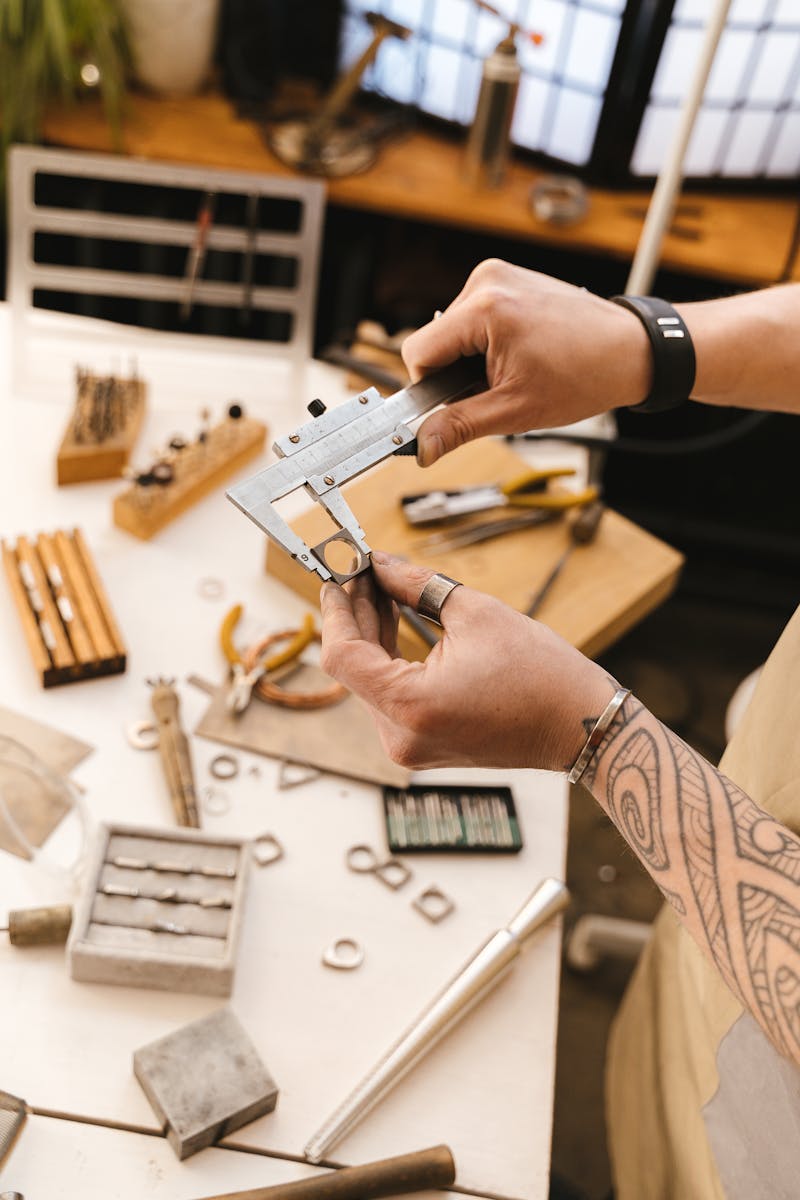
For the most accurate at-home measurement, consider ordering a plastic or metal ring sizer set. These are the same tools that professional jewelers use, and they are surprisingly affordable.
Plastic Ring Sizer Sets
Plastic ring sizers typically cost between two and five dollars and come as a set of rings in every half size. You slip each one onto your finger until you find the one that fits perfectly. Many online jewelry retailers, including Brilliant Earth and Blue Nile, will ship you a free plastic ring sizer if you request one.
Metal Ring Sizer Sets
Metal ring sizer sets, often called ring mandrels, are more durable and precise. They usually cost between ten and twenty dollars and are available on Amazon. These are a worthwhile investment if you buy jewelry regularly or want professional-grade accuracy.
How to Use Them
Slide the sizer rings onto your finger one at a time. The correct size should slide over your knuckle with slight resistance and sit comfortably on your finger without spinning. If a ring feels snug going over the knuckle but comfortable once in place, that is the right size.
Method 5: Use a Digital Ring Sizing App
Technology has made ring sizing even more convenient. Several smartphone apps now let you determine your ring size using just your phone screen or camera.
How Phone Screen Apps Work
Some apps display a series of circles on your phone screen. You place an existing ring on the screen and adjust it until the circle matches the inside of the ring. The app then tells you the size. These apps work similarly to printable circle sizers but eliminate printing errors.
How Camera-Based Apps Work
Newer apps use your phone camera and a reference object like a credit card to measure your finger width. You place the reference object next to your finger, the app calibrates the scale, and then calculates your ring size from the image.
Accuracy Considerations
Digital apps are convenient but can vary in accuracy depending on your phone screen resolution and how carefully you follow the instructions. They are best used as a secondary confirmation alongside a physical measurement method.
Method 6: Visit a Local Jeweler
If you want absolute certainty, visiting a jewelry store is still the gold standard for ring sizing. Most jewelers offer free ring sizing and it takes less than five minutes.
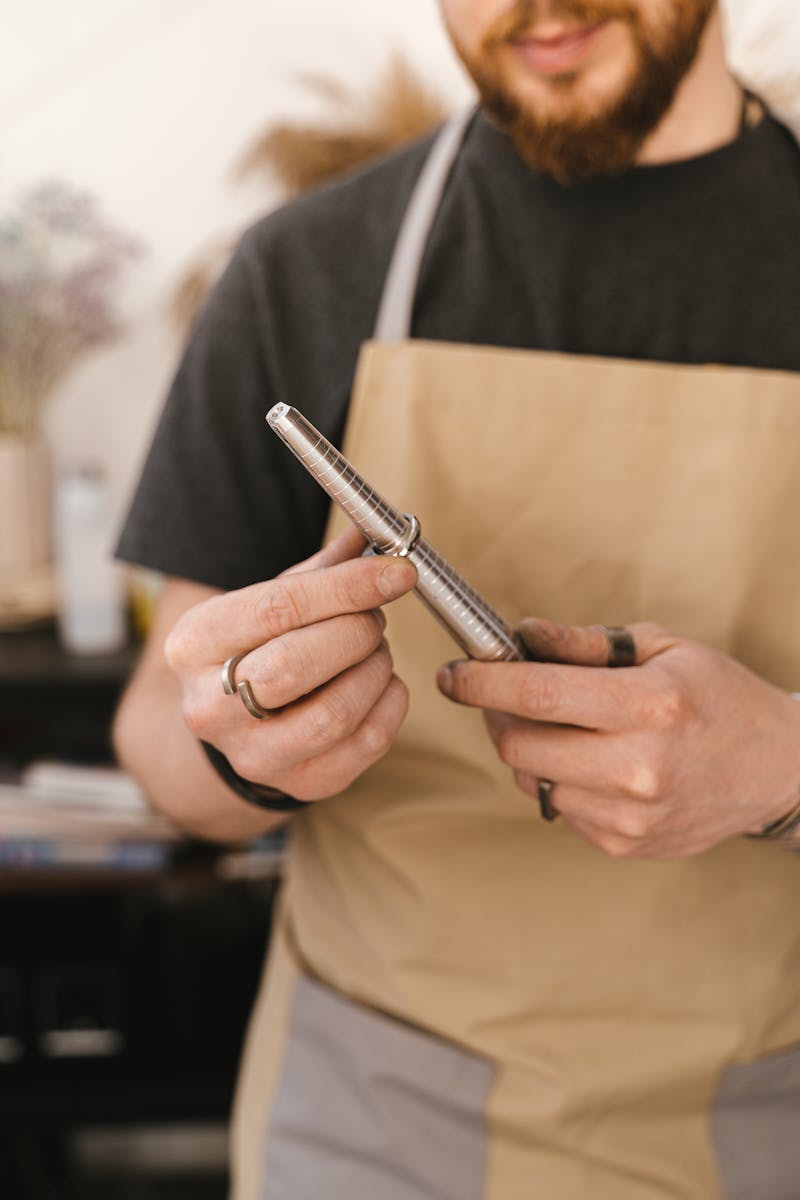
A jeweler will use a set of metal sizing rings called a ring gauge. They will have you try on several sizes until they find the perfect fit for the specific finger you need. Jewelers can also account for factors like ring width. Wider bands typically require a slightly larger size because they sit tighter on the finger.
Even if you plan to buy your ring online, there is nothing wrong with getting sized at a local jewelry store first. Most jewelers are happy to help, and you can always make your purchase elsewhere.
US Ring Size Chart With Measurements
Use this chart to convert your finger circumference or ring diameter into a standard US ring size. All measurements are in millimeters.
| US Ring Size | Inner Diameter (mm) | Inner Circumference (mm) |
|---|---|---|
| 3 | 14.0 | 44.0 |
| 3.5 | 14.4 | 45.2 |
| 4 | 14.8 | 46.5 |
| 4.5 | 15.2 | 47.8 |
| 5 | 15.7 | 49.0 |
| 5.5 | 16.1 | 50.3 |
| 6 | 16.5 | 51.5 |
| 6.5 | 16.9 | 52.8 |
| 7 | 17.3 | 54.0 |
| 7.5 | 17.7 | 55.3 |
| 8 | 18.1 | 56.5 |
| 8.5 | 18.5 | 57.8 |
| 9 | 18.9 | 59.0 |
| 9.5 | 19.4 | 60.3 |
| 10 | 19.8 | 61.6 |
| 10.5 | 20.2 | 62.8 |
| 11 | 20.6 | 64.1 |
| 11.5 | 21.0 | 65.3 |
| 12 | 21.4 | 66.6 |
| 13 | 22.2 | 69.1 |
International Ring Size Conversion
If you are ordering from an international jeweler, you may need to convert your US ring size to another system. Different countries use different sizing standards, which can be confusing. Here is a quick reference to help you navigate the most common systems.
How Different Countries Size Rings
The United States and Canada use a numerical system that runs in half-size increments, starting around size 3 and going up to size 16. The United Kingdom, Australia, and South Africa use an alphabetical system that starts at A and goes up to Z and beyond. European sizes are based on the inner circumference of the ring measured in millimeters, so a European size 52 means the ring has an inner circumference of approximately 52 mm. Japan and China use their own numerical systems that differ from the US scale.
Common Conversions
| US Size | UK Size | EU Size | Japan Size |
|---|---|---|---|
| 5 | J½ | 49 | 9 |
| 6 | L½ | 52 | 12 |
| 7 | N½ | 54 | 14 |
| 8 | P½ | 57 | 16 |
| 9 | R½ | 59 | 18 |
| 10 | T½ | 62 | 20 |
| 11 | V½ | 64 | 23 |
| 12 | X½ | 67 | 25 |
When shopping from international retailers, always double-check which sizing system they use before placing your order. Most reputable jewelers will list the sizing system on their product pages or in their size guides.
Tips for Getting an Accurate Measurement
Getting your ring size right the first time saves you the hassle of returns and resizing. Here are the most important things to keep in mind when measuring.
Measure at the Right Time of Day
Your fingers change size throughout the day. They tend to be smallest in the morning when you wake up and largest in the evening after a full day of activity. For the most representative measurement, size your finger in the late afternoon or evening. Avoid measuring first thing in the morning or right after exercise.
Account for Temperature
Cold weather causes your fingers to shrink, while warm weather makes them swell. Try to measure your ring size at a comfortable room temperature for the most accurate reading. If your hands are very cold or very warm, wait until they return to normal before measuring.
Measure Multiple Times
Do not rely on a single measurement. Measure your finger at least two or three times on different days and at different times of day. If you get slightly different results, the average of your measurements will give you the most reliable size.
Consider the Ring Width
Wider bands fit tighter than narrow bands. If you are buying a ring that is wider than six millimeters, consider going up half a size from your measurement. This is because a wider band covers more of your finger and creates more friction when sliding on and off.
Think About Your Dominant Hand
The fingers on your dominant hand are often slightly larger than those on your non-dominant hand. If you plan to wear the ring on your dominant hand, make sure you measure that specific finger rather than assuming both hands are the same size.
Common Mistakes to Avoid
Even with the right method, a few common errors can throw off your measurement. Here is what to watch out for.
Measuring Too Tight
When using the string or paper method, many people pull the string too tight around their finger. This gives a circumference measurement that is too small, leading to a ring that is uncomfortably tight. The string should be snug against your skin but not indented into it.
Ignoring Your Knuckle
If you have large knuckles relative to the base of your finger, you need to account for both. The ring must be large enough to slide over your knuckle but small enough to stay in place once it is on. In this case, measure both the knuckle and the base of the finger and choose a size that is between the two measurements.
Printing at the Wrong Scale
If you use a printable ring sizer, failing to print at exactly 100 percent scale is the most common mistake. Always check the verification measurement on the printout before using it. Even a small scaling error can result in a full size difference.
Using the Wrong Finger
This might sound obvious, but make sure you measure the exact finger you intend to wear the ring on. Your ring finger on your left hand can be a different size from your ring finger on your right hand. Even adjacent fingers on the same hand can differ by a full size or more.
Not Accounting for Swelling
If you have recently been exercising, consuming salty foods, or are pregnant, your fingers may be temporarily swollen. Wait until the swelling goes down before measuring. Similarly, if you have been in very cold conditions, wait until your fingers warm up to their normal size.
Ring Sizing for Special Situations
Sizing for a Surprise Proposal
Planning to pop the question? Getting your partner’s ring size without giving away the surprise takes a bit of creativity. Here are some tried-and-true strategies.
Borrow one of their existing rings from their jewelry box. Make sure it is one they wear on the same finger, and either measure it yourself or take it to a jeweler. You can also enlist a friend or family member to take them ring shopping casually or to ask about their ring size in a natural conversation.
Another option is to trace the inside of one of their rings on a piece of paper and bring the tracing to the jeweler. If you are still unsure, most jewelers offer free resizing within a certain window after purchase, so it is better to make your best guess and have it adjusted later than to delay the proposal indefinitely.
Sizing for Wide Bands
As mentioned earlier, wider bands require special consideration. A ring that is eight millimeters wide or more will feel noticeably tighter than a two-millimeter band in the same size. The general rule is to go up by half a size for bands between six and eight millimeters wide, and a full size up for bands wider than eight millimeters.
Sizing for Arthritis or Swollen Joints
People with arthritis or swollen knuckles face a unique challenge: the ring needs to be large enough to fit over the knuckle but small enough not to spin freely on the finger. In this case, consider rings with built-in sizing solutions like spring-loaded shanks, ring guard inserts, or open-back adjustable designs that can expand over the knuckle and then contract to fit snugly on the finger.
Sizing for Children
Children’s ring sizes typically range from size 1 to size 4. Because children are still growing, consider adjustable rings rather than fixed sizes. If you do buy a fixed-size ring for a child, keep in mind that they may outgrow it within a year or two.
Frequently Asked Questions
What is the average ring size for women?
The average ring size for women in the United States is between size 6 and size 7. However, ring size depends heavily on body type, height, and bone structure, so this is just a general guideline. Always measure rather than guess.
What is the average ring size for men?
The average ring size for men in the United States is between size 9 and size 10. As with women’s sizes, this varies significantly based on individual factors, so measuring is always recommended.
Can I measure my ring size with a tape measure?
Yes, a flexible fabric tape measure works well. Wrap it around the base of your finger and read the measurement in millimeters. Then use the ring size chart in this article to find your corresponding size. If your tape measure only shows inches, multiply the inch measurement by 25.4 to convert to millimeters.
How accurate are online ring sizers?
Online and app-based ring sizers can be reasonably accurate if you follow the instructions carefully. However, they are generally considered less reliable than physical measurement methods. Use them as a secondary reference rather than your only measurement.
Does ring size change with age?
Yes, ring size can change over time. Weight gain or loss, hormonal changes, aging, and medical conditions can all affect finger size. It is a good idea to re-measure your ring size every few years or before any significant jewelry purchase.
What should I do if I am between two sizes?
If your measurement falls between two sizes, it is generally best to choose the larger size. A ring that is slightly loose is more comfortable and easier to remove than one that is too tight. You can always add a ring size adjuster to make a slightly large ring fit more snugly.
Can a jeweler resize any ring?
Most rings can be resized up or down by one or two sizes. However, some materials and designs are more difficult to resize. Rings made of tungsten, titanium, or ceramic cannot be resized. Rings with eternity settings, intricate patterns that go all the way around, or tension settings may also be difficult or impossible to resize. Check with your jeweler about resizing options before purchasing.
How much does ring resizing cost?
Ring resizing typically costs between twenty and one hundred dollars depending on the material, the complexity of the design, and how much the size needs to change. Many jewelers offer free resizing for rings purchased from their store within a certain time period, so always ask about this before buying.
Conclusion
Learning how to find your ring size at home is simpler than most people think. Whether you use the classic string method, measure an existing ring, download a printable sizer, or order a professional ring gauge, you can get an accurate measurement in just a few minutes. The key is to measure at the right time, account for factors like ring width and temperature, and double-check your results.
With your ring size in hand, you can shop confidently from any jeweler in the world, whether it is a local boutique or an international online store. No more guessing, no more returns, and no more rings that end up sitting unworn in a drawer because they do not fit.
If you found this guide helpful, check out our other articles on how to find a job and how to find cheap flights for more practical, step-by-step advice on everyday challenges.